Summary
When should OTE be ticked in Payroll Configuartion
End Result
To determine if OTE needs to be selected at your school.
Method
In Payroll > Payroll Configuration Maintenance > Calculate and Submit OTE
Does this need to be ticked - No*
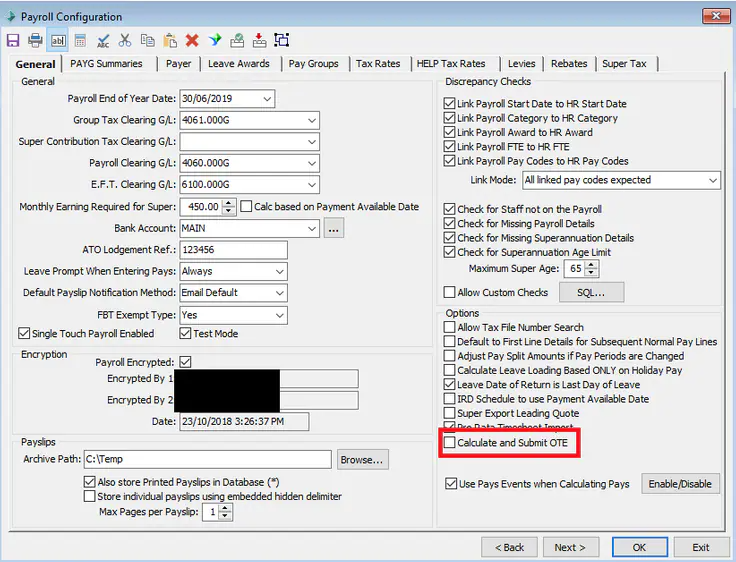
Under Single Touch Payroll Reporting, an employer must report the Superannuation Guarantee Contribution (SGC) amount that they are paying to an employee with each pay.
There are some rare situations where an employer may not be able to calculate an SGC amount for an employee. In those situations the Ordinary Time Earnings of the employee must be submitted instead. The ordinary time earnings is the earnings on which an employer is obliged to pay superannuation guarantee.
For most organisations, they will not need to worry about the Ordinary Time Earnings as they will be able to supply an SGC amount or equivalent for each employee in their reporting to the ATO.
As calculating and submitting Ordinary Time Earnings introduces an overhead on managing pay codes and employees, we have put all Ordinary Time Earnings functionality behind a configuration key. If you can supply an SGC amount for all employees (even if that amount is 0 as they didn't reach the earnings threshold) you do not need to turn on ordinary time earnings functionality at all.
'Include in Superannuation Calculation' vs 'Contributes to OTE'
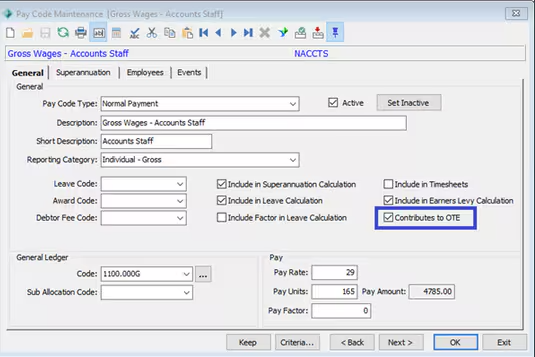
If you have turned on OTE calculations you will see an additional flag against each pay code type called 'Contributes to OTE'.
Within Synergetic there was already a field on pay codes called ‘Include in Superannuation Calculation’ which was used to determine whether or not super would be paid on pay lines of that pay code type. With STP the ‘Include in Superannuation Calculation’ flag continues to be the mechanism by which the pay amounts relevant to super are determined.
We introduced a separate flag for the OTE calculation that may be submitted to the ATO as we are aware many organisations pay Superannuation on more than the ordinary time earnings that they are obliged to.
Was this article helpful?
That’s Great!
Thank you for your feedback
Sorry! We couldn't be helpful
Thank you for your feedback
Feedback sent
We appreciate your effort and will try to fix the article